
What Stage Is Your Ketamine Clinic In? A Complete Guide
Synopsis: Discover the four life cycle stages every ketamine clinic goes through—from infancy to exit. Learn how to identify your current stage and make strategic, values-aligned decisions instead of reactive ones. Whether you're surviving startup chaos, defining your identity, optimizing for growth, or navigating a crossroads, understanding your stage helps you build a practice that serves both your patients and your life.
KEY TAKEAWAYS
Your ketamine clinic goes through four predictable life cycle stages, each with unique challenges:
- Stage 1 - Infancy (Survival): Focus on cash flow, patient acquisition, and preventing burnout while building your foundation
- Stage 2 - Teenage Years (Identity): Define who you are, what you stand for, and make strategic decisions aligned with your values
- Stage 3 - Prime Adult (Legacy): Optimize systems, grow strategically, and build lasting impact in your community
- Stage 4 - Midlife & Beyond (Clarity): Decide whether to reinvent, downsize, or exit—from purpose, not fear
Bottom line: Success isn't advancing quickly through stages. It's making informed, value-based decisions at whatever stage you're in right now.
Table of Contents:
Find Your Clinic's Current Stage (Quick Reference Table)
Frequently Asked Questions About the Ketamine Clinic Life Cycle
Introduction
You're four years into your ketamine clinic. Patient flow is consistent, and you're providing a needed service in your community. Your patients are happy. Your referring providers are happy. Everyone is happy…but you are exhausted. Your clinic has been your baby, and now you're wondering, like that sleep-deprived first-time parent: Will I ever get to sleep again? You might even be questioning why you started this to begin with. Life was simpler before. Maybe it's time to hire up or sell to private equity.
How did you end up here? More importantly, where do you go next?
The Problem:
There's a saying: "Life imitates art." We say business imitates life. In your case, your clinic imitates life. Your clinic goes through stages, each with unique challenges and milestones.
Not understanding these stages leads to reactive decisions instead of proactive ones. You're already overwhelmed serving your patients. What worked in an earlier stage won't work in another. So what's a clinic owner to do?
The Solution:
Understand the life cycle stages of your business. Like a human, your clinic goes through predictable stages. Each has unique challenges, opportunities, and priorities. Knowing your stage helps you assess whether you're meeting your milestones.
External events, even "Acts of God" can derail the cycle or cause regression. But regardless of these uncontrollable variables, knowing your life cycle stage supports you in making value-based decisions instead of reactive, defensive ones.
The Promise:
In this guide, you'll discover the four life cycle stages every ketamine clinic goes through and identify exactly where your clinic is right now.
The Ketamine Clinic Life Cycle Overview
Like a human moving from birth to midlife and beyond, your ketamine clinic has predictable stages. Each stage has unique priorities, challenges, and milestones, similar to stages of human development.
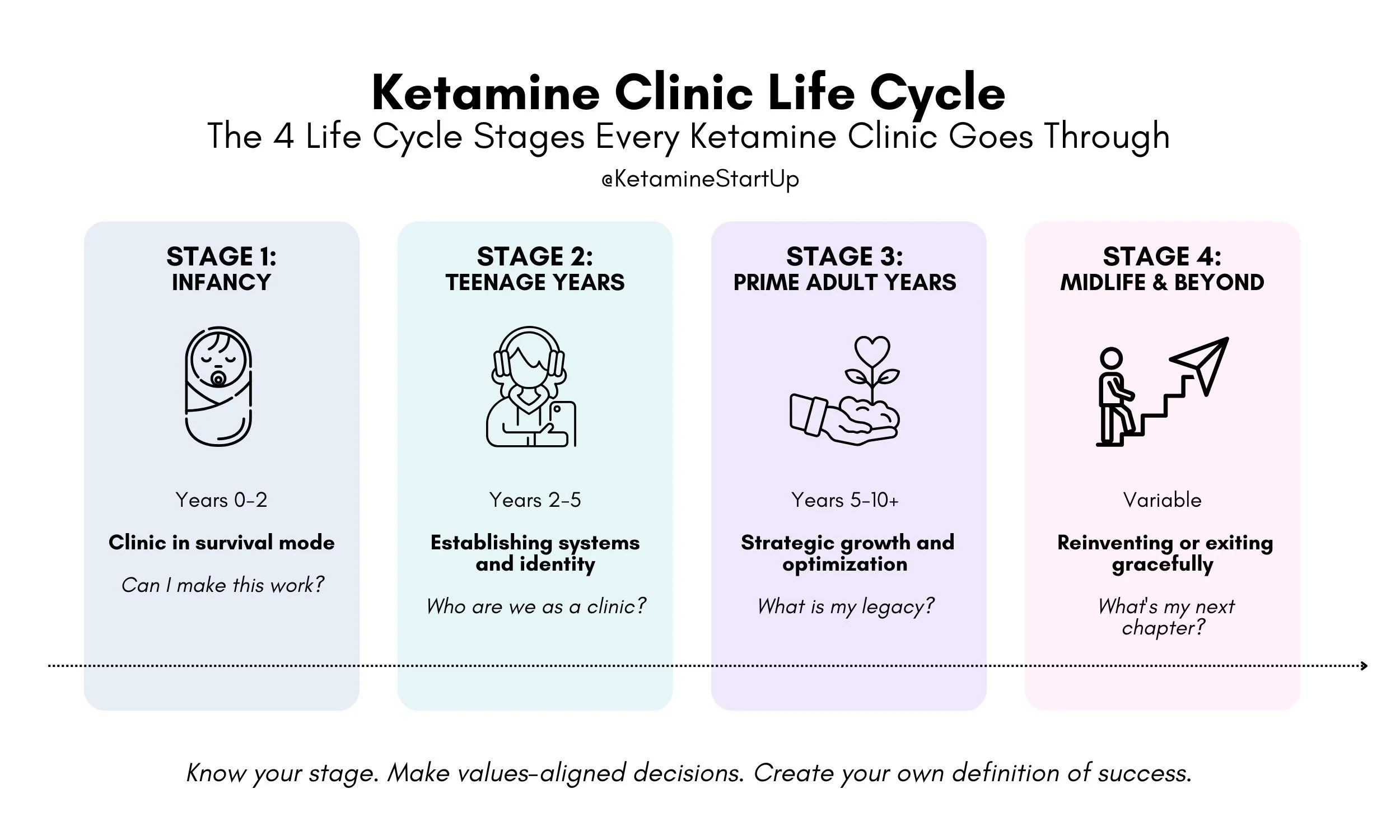
Every ketamine clinic moves through four predictable stages. Each with unique challenges and decisions. Knowing your stage helps you stop comparing yourself to others and start making values-aligned choices for your practice and your life.
A few things to note: stage timelines vary. Your location or personal circumstances may extend your infancy period. You can get stuck in a stage or regress to an earlier one. Socioeconomic shifts, political changes, or even a car bomb explosion (in our case) can pause your advancement.
But advancement isn't the goal. The goal is to make informed, value-based decisions at whatever stage you're in.
Many of you are probably in the first or second stage, as ketamine therapy is still a growing industry. However, some of you may be in an accelerated life cycle.
What does that look like? Some clinic owners discovered private practice wasn't for them, or they were busier than they realized, and exited their practice. Others were approached by private equity and acquired.
But before we get ahead of ourselves, let’s dive into each stage in detail.
The Ketamine Clinic Life Cycle at a Glance
Before we dive deep into each stage, here's a quick reference guide to help you identify exactly where your clinic is right now and what you should be focusing on:
| Stage | Timeline | Core Focus | You're Here If... | Key Challenge | Critical Decision |
|---|---|---|---|---|---|
| Stage 0: Pre-Opening (Contemplation) | Variable (weeks to years before opening) | Research and decision-making |
|
Decision paralysis waiting for the "perfect time" | Am I really going to do this, or am I waiting forever? |
| Stage 1: Infancy (Survival) | First 6 months of operation | Sane survival |
|
Burning through runway while maintaining sanity and health | What am I willing to sacrifice, and how much? |
| Stage 1.5: Toddler Years (Foundation Building) | 6 months to 2 years | Systems and culture development |
|
Foundation setting that will impact long-term success | What kind of practice am I building? |
| Stage 2: Teenage Years (Identity) | Years 2-4 (variable) | Identity formation and differentiation |
|
Defining who you are without losing yourself to trends or comparison | Who are you as a clinic? What do you stand for? |
| Stage 3: Prime Adult Years (Growth & Legacy) | Years 4-10+ (variable) | Strategic growth and legacy building |
|
Strategic growth aligned with your values, not external pressure | What is your legacy? What do you want to see next? |
| Stage 4: Midlife & Beyond (Reinvention or Exit) | Years 10+ (variable, can happen earlier) | Clarity over fear in major transitions |
|
Making decisions from clarity rather than fear or panic | What does my next chapter look like? |
Now let's explore each stage in detail, including the two transitional phases (Stage 0 and Stage 1.5) that provide important context for your clinic's journey.
Prefer to Listen?
If you'd rather listen to this content on your commute, during a workout, or while reviewing your clinic operations, we have a podcast episode on this very same topic Episode 051 - The 4 Ketamine Clinic Business Stages: How to Know Where You Are and What to Do Next
The Four Stages of The Ketamine Clinic Life Cycle

The infancy stage of a ketamine clinic: sleepless nights, regulatory challenges, and the excitement of transforming your first patients' lives.
Stage 1: Infancy (Survival)
Congratulations, you have a new baby clinic! Hello sleepless nights, overthinking, and excitement. You're working 80+ hours between caring for this clinic and fulfilling responsibilities at your salaried position. You look into the proverbial eyes of your clinic and see your hopes and dreams reflected back: the excitement of a new adventure and changing patient lives, mixed with dread about the challenges you've only researched and mentally prepared for.
You’re here if:
Your patient volume is inconsistent
Clinic revenue doesn't cover expenses yet
You wear every hat: clinician, marketer, scheduler, biller
You question this decision weekly (or daily)
Your Core Challenge: Sane Survival
You're burning through your runway (money set aside to cover expenses) faster than anticipated while making sure you've crossed every regulatory T and dotted every compliance I: licenses, permits, insurance. Meanwhile, you're attempting to market and connect with your medical community to get patients through the door. Every patient and every dollar matters.
But if you get busy at the cost of your mental, emotional, and physical health, burnout looms. If you can't find a sustainable rhythm, infant mortality (closing your clinic) is a very real concern.
Key Decision: What Am I Willing to Sacrifice, and How Much?
No pain, no gain applies to this early stage. Just as you sacrifice sleep to care for an infant, you'll sacrifice something for this baby clinic. By deciding what you're willing to give up (early mornings before the kids wake) and what's non-negotiable (Sunday night family dinners), you create clear boundaries. This shifts the question from "Can I survive?" to "How can I survive sanely and sustainably?"
→ Full guide: Starting Your Ketamine Clinic: The Infancy Stage (coming soon)

The teenage years of your ketamine practice: You've survived startup chaos and now face the challenge of defining who you are as a clinic.
Stage 2: The Teenage Years (Systems and Stability)
Your clinic survived the harrowing infancy years. You have systems in place, resulting in consistent patient flow. Revenue finally covers expenses. You no longer need to hand-feed your clinic. You have stability. Now come the teenage identity questions: Who are you? What do you stand for? Where are you going next?
You’re here if:
You're profitable (revenue exceeds expenses)
Patient flow is consistent
Systems are in place, from scheduling to clinical protocols
You're thinking, "What's next for my clinic?"
Your Core Challenge: Identity Formation
Remember those hopes and dreams you had for your clinic before you got too busy simply trying to survive? You're no longer in survival mode. Now you have time to breathe and strategize. Should you niche down and focus only on treatment-resistant depression? Should you add TMS? Is it time to expand into a larger space or open another location? Without clarity on who you are and what you stand for, you can end up confused, misguided, and in a place you never intended. Sound familiar? That's the teenage years.
Key Decision: Who Are You as a Clinic?
The teenage years are confusing: trying to fit in with what's popular or rebelling against the establishment. This stage is no different for your clinic. It requires you to double down on your values and remember why you started this clinic in the first place. Who you are goes beyond marketing and pretty brand colors. Your identity is linked to both your business and practice philosophy. Focusing on who you are prevents you from saying yes to patients who aren't a good fit or adding services you aren't ready to handle.
→ Full guide: Stabilizing Your Ketamine Clinic: The Teenage Years (coming soon)

The prime years of your ketamine clinic: Systems run smoothly, revenue is strong, and now you're asking the legacy question—what impact do I want to make?
Stage 3: The Prime Adult Years (Growing and Optimizing)
Your clinic can run on its own. It's a well-oiled machine with automations, seasoned staff, and efficient systems. Long gone is the awkwardness of the teenage stage. You know who you are and what you stand for. You have years of experience demonstrating you know your stuff. Patients' lives have been transformed, and you have a strong network of referring providers. Business is good. You've achieved balance between running your practice and enjoying the fruits of your labor. But now you might be thinking: What's next? What is my legacy?
You’re here if:
Your profitability is consistent month to month
You have a strong team culture with multiple staff members you trust
Your brand is recognized in your community or region
Systems are effective enough that micromanaging isn't necessary
Your Core Challenge: Strategic Growth
Now that you've achieved the stability and sustainability you could only dream of in earlier stages, your core challenge is growth. Not growth for growth's sake, but growth strategically aligned with your values and the goals you set out to accomplish. Others may tell you it's time to scale up, add more providers, and offer new services. Like the teenage years, external voices tell you what you "should" do. Unlike that earlier stage, however, you're solid in who you are. Overcoming past challenges and achieving success has given you confidence to forge ahead. But which opportunity will serve your goals?
Key Decision: What Is Your Legacy?
If you're familiar with our podcast and blog, you know we talk often about your "why": your reasons for starting a ketamine clinic. Your why is your north star, guiding you through challenges in each stage. Your legacy is closely tied to your why. It's the purpose that lives beyond your why in tangible, concrete form.
So what do you want to see next? Build a regional ketamine therapy empire? Step away from day-to-day operations and spend more time with family? Become a thought leader and train the next generation of providers? Only you can answer this. The only wrong answer is one that isn't aligned with what you truly want.
→ Full guide: Optimizing Your Ketamine Clinic: The Prime Adult Years (coming soon)

The crossroads stage: Whether facing burnout, market shifts, or life changes, you're asking—what does my next chapter look like, and how do I honor what I've built?
Stage 4: Midlife & Beyond (Reinventing to Exiting)
It's like that feeling you get in fall: a shift in seasons. You can't deny the feeling that the sun is setting on your clinic. Or perhaps it's time for the clinic and you to part ways. What brought this fun yet challenging adventure to this point? Perhaps your health has changed, or new priorities put family over business. Maybe demand for your services has declined. You might just be burned out and done. Whatever it may be, you've changed, and the trajectory of your clinic will too.
You’re here if:
Your clinic's growth has declined or plateaued
You no longer feel connected to your original reason for starting
You don't feel like facing increased competition or navigating regulatory challenges
Personal life changes can't be ignored (family, health, retirement)
Your Core Challenge: Clarity Over Fear
Remember when day-to-day functions depended only on you? When you couldn't figure out who you were or how to differentiate yourself? When you decided to expand and add new providers to grow the clinic? What helped you successfully navigate these decisions throughout the stages was returning to your values. This final stage is no different.
However, what's unique to this stage is reconnecting with the person you've become as your clinic grew. The core challenge is making a decision about your clinic's future from clarity instead of fear. It's scary to see your clinic's success plateau or decline. Acting reactively instead of from your values can lead to panic-selling your practice or adding services that hurt more than help. With clarity, you can decide whether it's time to gracefully exit, reinvent, or downsize.
Key Decision: What Does My Next Chapter Look Like?
Connected with your values, what does your next goal look like? Now add this: how do your current circumstances influence or alter this goal? Are your health and energy levels up to reinventing your business or starting a new one? Have your priorities changed, and are you ready to return to a smaller, simpler practice? Are you happy with this wild and unexpected ride and ready to say goodbye?
Whatever your answer, let it honor both who you've become and what you've built.
→ Full guide: Transitioning Your Ketamine Clinic: Midlife & Beyond (coming soon)
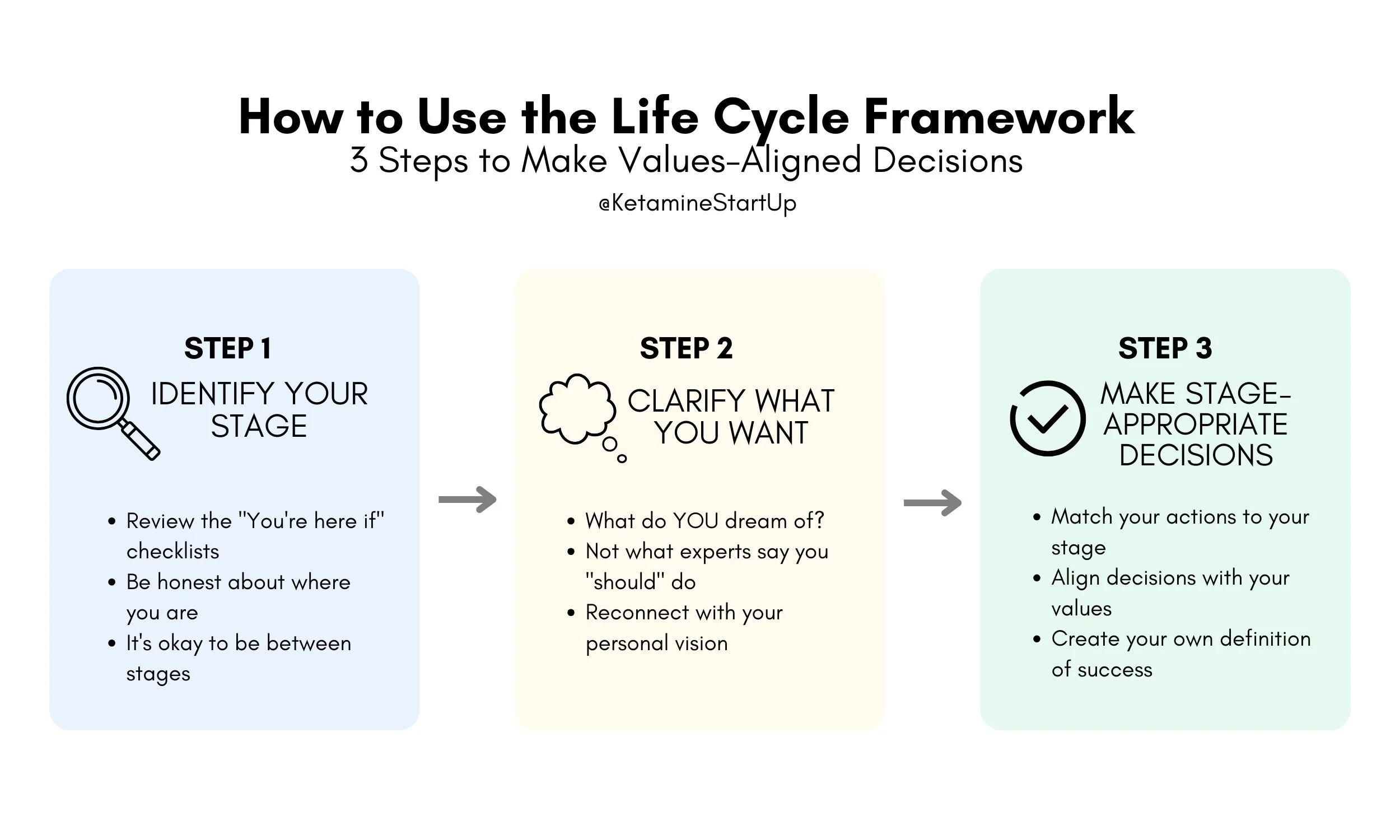
Making strategic decisions for your ketamine clinic starts with honest self-assessment, reconnecting with your vision, and choosing actions aligned with both your stage and your values.
How to Use This Framework
Now that you understand each stage, let's make this actionable. Here's how to use this framework:
1. Identify Your Stage
Be honest with yourself as you assess which stage you're in. Review the "You're here if" sections above. Which one fits you best? If you're struggling to decide, imagine what your biggest fan and your harshest critic would say about your current stage. Taking on someone else's perspective can release the overthinking.
You might find yourself between two stages. That's completely normal. The goal isn't to clearly identify with one stage or the other but to clarify your current reality.
2. Clarify What You Actually Want
Take time to identify what you actually want from your business. What do you personally dream of? Not what experts or thought leaders tell you to do. Put your blinders on and search within, especially if you've never taken time to think about it or have forgotten.
3. Make Stage-Appropriate, Value-Based Decisions
Equipped with knowledge of your stage and your goal, what actions do you need to take? For example, if you want to own three clinics and dominate ketamine therapy in your region but your clinic is still in infancy, your actions should be survival-based (see Stage 1 above). But as you navigate these actions, make decisions aligned with your personal values.
Taking our example further: sure, you could spend all your time working on your baby clinic, but if you value family time, set clear boundaries to protect it.
Conclusion
What does a successful ketamine clinic look like? Using the life cycle framework, success is more than advancing to the next stage or maturing faster than other clinics. It's not about making more money than your salaried hospital position or selling to private equity for a fortune.
Success looks different for each clinic owner. Comparing yourself to other practices or listening to what experts say you "should" do can lead you astray. Your job is to be self-aware, making decisions based on your values as you navigate each stage. This is how you create your own definition of success.
The service you're providing your community with ketamine therapy is deeply needed. You were drawn to this industry because you saw a way to provide healing treatment that transforms lives. Like your patients, you'll also transform as your clinic moves through the stages. But the key is not losing yourself. Stay connected to yourself by making decisions from clarity, not comparison or fear.
Ready to dive deeper? Explore each stage in depth:
→ Stage 1: Infancy - Starting Your Ketamine Clinic: Surviving the Infancy Stage (Years 0-2)
→ Stage 2: Teenage Years (coming soon)
→ Stage 3: Prime Adult Years (coming soon)
→ Stage 4: Midlife & Beyond (coming soon)
Business Education Disclaimer: The following information is for educational purposes only and does not constitute legal, financial, or business advice. Regulatory requirements, licensing laws, and business practices vary by state and jurisdiction. Always consult qualified attorneys, accountants, and business advisors for specific practice decisions.
Frequently Asked Questions About the Ketamine Clinic Life Cycle
How long does each stage of the ketamine clinic life cycle last?
Stage timelines vary significantly based on your location, personal circumstances, and business decisions. Infancy typically lasts 6 months to 2 years (until you're consistently profitable). The teenage years usually span years 2-4 as you establish your identity and systems. Prime adult years can last 5-10+ years depending on your growth trajectory and goals. Midlife and beyond can happen at any point when personal or business circumstances change. Some clinics move through stages faster, while others stay in a stage longer. The goal isn't to advance quickly but to make informed, value-based decisions at whatever stage you're in.
Can I skip a stage in the clinic life cycle?
No, you cannot skip stages entirely. Just as humans must go through childhood before adolescence, your clinic must establish survival (infancy) before forming identity (teenage years). However, you might move through a stage very quickly. Some well-funded or highly experienced clinic owners spend only months in infancy before reaching profitability and entering the teenage stage. What's important is addressing each stage's core challenges, even if briefly, before moving forward.
What if I'm stuck in a stage and can't seem to progress?
Getting stuck in a stage is common and not necessarily a problem. First, ask yourself: do I actually want to progress, or am I content where I am? If you're profitable and happy in the teenage stage, staying there is perfectly valid. If you want to progress but feel stuck, identify which challenge is holding you back. For example, if you're stuck in infancy, is it funding, patient acquisition, or burnout? Address the specific challenge systematically. Consider working with a coach, joining a peer group, or taking courses specific to your challenge. Remember: progress isn't always the goal—making value-aligned decisions is.
Can my clinic regress to an earlier stage?
Yes, absolutely. External events like regulatory changes, economic downturns, natural disasters, or personal crises can cause regression. For example, a clinic in the prime adult stage might regress to the teenage stage after losing key staff members or facing new competition that forces identity re-evaluation. A clinic in the teenage stage might regress to infancy if a major expense depletes cash reserves. Regression isn't failure. It's part of the business cycle. The key is recognizing it early and applying stage-appropriate strategies to stabilize and move forward again.
Which stage is the most critical or important?
Every stage is critical in its own way. Infancy determines whether you survive long enough to build a practice. The teenage years determine your long-term identity and trajectory. Prime adult years determine your legacy and impact. Midlife and beyond determines how you exit gracefully. The stages build upon each other, each subsequent stage reliant on the growth that occurred in the prior stage. If forced to choose, it’s the stage YOU are in. What’s most important is being honest with yourself about what stage you are in and taking action that is appropriate and needed for that stage. Not ruminating on the regret of the prior stage, nor being anxious about what is to come in the next stage.
How do I know when I'm transitioning between stages?
Transitions are often gradual rather than sudden. You're transitioning from infancy to teenage years when you achieve consistent profitability and find yourself asking "who are we?" instead of "will we survive?" You're transitioning from teenage to prime adult when you have a clear identity, established brand recognition, and are asking "what's my legacy?" instead of "who are we?" You're transitioning to midlife when you feel disconnected from your original purpose, face declining growth, or experience significant personal life changes. If you're between stages, focus on what feels most pressing right now. That will indicate your current stage.
What if I don't fit neatly into one stage?
Not fitting perfectly into one stage is completely normal, and honestly you’ll probably have characteristics of multiple stages. For example, you might have some characteristics of infancy (inconsistent revenue) but others of the teenage stage (clear identity). The goal isn't perfect categorization but self-awareness about your current challenges. Focus on whichever stage description resonates most with your biggest current challenge, and apply those strategies. The framework is a guide, not a rigid prescription.
How do external events affect my clinic's life cycle stage?
External events such as regulatory changes, economic shifts, natural disasters, pandemics, personal health crises can pause advancement, cause regression, or accelerate transitions. For example, COVID-19 forced many clinics to rapidly adopt telemedicine (accelerating systems development), while others lost patient volume and regressed to survival mode. A car bomb explosion near our clinic (yes, this happened to us) paused our growth.. These events are uncontrollable but understanding your stage helps you respond strategically rather than reactively. Return to your values and apply stage-appropriate strategies even during chaos.
What should I focus on in each stage?
In Infancy, focus on survival: manage cash flow, establish basic systems, acquire initial patients, and prevent burnout. In the Teenage Years, focus on identity: clarify your values, define what makes you different, build brand recognition, and make strategic decisions about growth. In Prime Adult Years, focus on legacy: strategic expansion, optimizing systems, developing leaders, and building lasting impact. In Midlife & Beyond, focus on clarity: reconnect with your values, assess whether to reinvent or exit, and make decisions from purpose rather than fear.
Can I use this framework if my clinic isn't a traditional private practice?
Yes. The life cycle stages apply to any business—healthcare or otherwise. Whether you run a telemedicine practice, integrated wellness center, bookstore, or consulting firm, the core challenges (survival, identity, growth, exit) are universal to entrepreneurship. Simply adapt the specific examples to your business model. The principle remains: understand your stage, clarify what you want, and make value-based decisions appropriate to where you are right now.
If you enjoyed this blog, check out these posts too:
The Clinician’s Guide to Ketamine Therapy: A Brief History | Part 1
In Part 1 of our Clinician’s Guide to Ketamine Therapy, we explore the history of ketamine—from its roots in pharmaceutical chemistry to its rise as a battlefield anesthetic and eventual reputation as a recreational drug. Understanding this history is key to appreciating ketamine’s legitimacy as a medical tool and its evolving role in interventional mental health and chronic pain care.
Ketamine Clinic Marketing Funnel: How to Convert Prospects Into Patients
Learn the medical marketing funnel that transforms cold prospects into warm, ready patients for your ketamine clinic. This guide covers the 3-stage ACC framework (Awareness, Consideration, Conversion) and shows you how to create content that attracts ideal patients while letting unqualified leads self-select out.
13 Best Practices For Ketamine Therapy Clinics
Discover 13 best practices to help you start, grow, and refine your ketamine clinic. Learn how to improve patient care and build a thriving practice.

Discover the 4 life cycle stages every ketamine clinic goes through. Identify where you are now and make strategic, values-aligned decisions for growth.


Survive your ketamine clinic's first 0-2 years. Master funding, patient acquisition, and burnout prevention with proven strategies from clinic owners who've been there.